

If you’ve been on Pinterest for more than a week, you’ve probably heard someone say “post fresh pins.” But what does that actually mean? And why does it feel like everyone has a slightly different answer?
We’ve been creating pins professionally for years, and the concept of freshness is probably the single most misunderstood part of Pinterest strategy. So let’s clear it up and talk about what it actually takes to build a content machine that works long after you’ve hit publish.
What Is a Fresh Pin, Really?
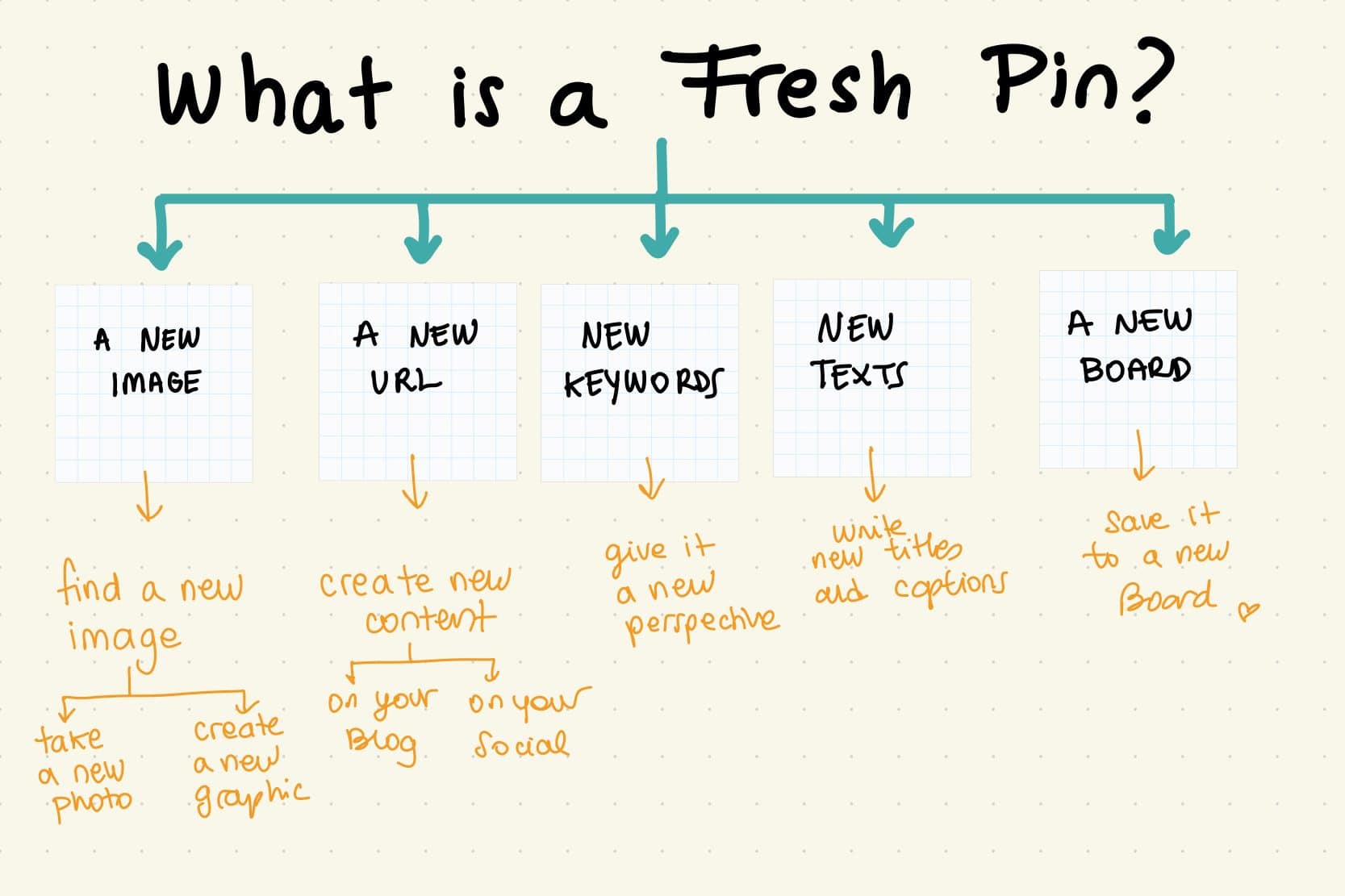
According to research analyzing millions of pins, true freshness requires all of the following: a new URL, a new image, new keywords, new text, and a new board.
The first time a piece of content appears on Pinterest, it receives maximum distribution. After that, every re-share, duplicate, or near-copy gets less.
Think of it this way: Pinterest’s algorithm is looking for content it hasn’t seen before. Every element of your pin — the visual, the text overlay, the description, the board it lives on — contributes to a kind of fingerprint. The more unique that fingerprint, the more likely Pinterest is to push it to new audiences.
What freshness is not: changing “easy lunch recipes” to “easy dinner ideas” and calling it a new pin. That’s not fresh. That’s a copy with a synonym.
Why We’ve Been Doing This for Years
We started building fresh pin systems back when Pinterest was still being treated like a dumping ground for repins. You’d see the same image recycled dozens of times across hundreds of boards, and for a while, that worked.
Then Pinterest got smarter.
The platform shifted — heavily — toward rewarding original content and penalizing duplicate flooding. Creators who had built their strategy on volume and repetition watched their reach collapse. Creators who had invested in genuinely new visuals, varied angles, and real keyword research kept growing.
We were in the second camp, and it changed how we think about content entirely. Every pin we create now is built with the assumption that it needs to stand on its own. Not because of a rule. Because it genuinely works better that way.
The average lifespan of a pin is 13 months. That means a pin you create today can still be driving saves and clicks more than a year from now — if it’s built right. That’s not something you get from most platforms.
We believe spending your marketing budget on Pinterest will pay off.
What Makes a Good Pin
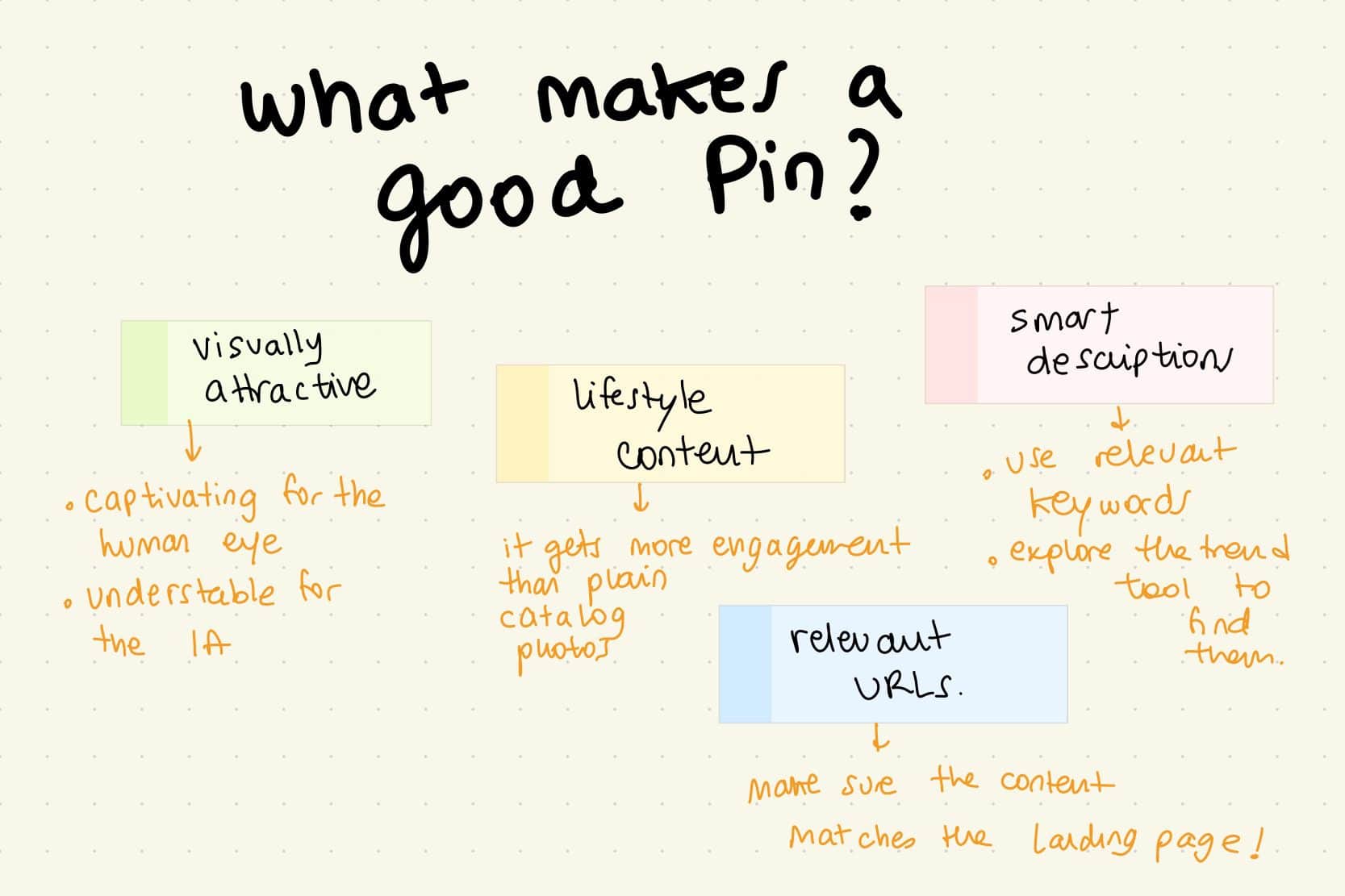
A strong pin does three things at once: it catches the eye, it answers a question, and it makes someone want to save it for later.
Visually, Pinterest’s AI is reading your images the same way a person does — but faster and more literally. It’s detecting objects, colors, textures, lighting, and composition. It’s asking: is this image clear? Is it well-lit? Does it show a product or idea in context, or just floating on a white background?
Lifestyle context almost always outperforms isolated product shots. A white ceramic vase on a wooden table next to a window performs better than the same vase on a white background. That context tells a story; you need to help people imagine it in their own home.
Text overlays still matter, but keep them tight. No more than four or five words. They should be readable at a glance, not decorative. If someone has to zoom in to read your text, you’ve already lost them.
Descriptions are where your keywords live. Write them the way a person actually searches — not “home decor” but “small living room bookshelf ideas for apartments.” Pinterest now understands semantic relationships, so you don’t need to stuff keywords, but you do need to be intentional. Natural, specific language beats generic captions every time.
Links matter more than most people think. A broken link or a mismatched landing page is a signal to Pinterest that your content is low quality. If your pin promises “10 easy weeknight dinners” and the link goes to a homepage, that’s a problem. Keep your links working and your landing pages relevant.
If you have only a homepage and you are trying to sell your services, organic Pinterest Marketing is not for you, yet.
What It Takes to Create Fresh Pins Consistently
The honest answer: a system.
One of my first jobs on Upwork asked for a Pinterest Architect, and I think I have become one now.
Winging it doesn’t scale. If you’re waiting for inspiration to strike before you open Canva, you’ll either burn out or post inconsistently — and inconsistency is one of the fastest ways to watch your monthly views drop.
Here’s the framework we use:
Start with research, not design. Before touching a template, go to Pinterest Trends and find out what your audience is searching for right now — and what they’ll be searching for in 45 to 60 days. For major seasonal moments, you need to be publishing content before demand peaks, not during.
Build content clusters, not single pins. For every piece of content — a blog post, a product page, a recipe — create multiple pins that are genuinely different from each other. Different image. Different angle. Different text overlay. Different target keyword. Different value proposition. Not just different colors.
Post 2 to 5 fresh pins per day depending on how much content you’re working with. More than that and quality suffers. Less than that and momentum is harder to build.
Track what’s working, but give it time. Some pins take off in the first week. Others build slowly over months. The 13-month lifespan means you’re playing a long game. Look at week-over-week growth across a 2 to 3 month window, not day-to-day spikes.
Adapt your content to the seasons. If you have a recipe that would be a good match for different occasions, use that to your benefit and create pins, adding different context to the same content.
What Pins Are Not Worth Your Time
Not all pin formats and strategies are created equal. Here’s what we’ve stopped doing — and why.
Recycled content without variation. If you’re creating 30 to 50 pins for the same blog post but they all use the same layout with slightly different colors, you’re not creating fresh content. You’re creating noise. Pinterest can detect near-duplicates, and flooding the platform with them tends to hurt distribution rather than help it.
Clever captions that don’t match how people search. Your wit is charming. Pinterest’s search algorithm doesn’t care. Title and description copy that prioritizes cleverness over clarity consistently underperforms. Save the wordplay for Instagram.
Sporadic posting. One pin this week, zero next week, five the week after. Pinterest rewards consistency. An account that posts two solid pins every day will almost always outperform one that posts ten on Monday and nothing for the rest of the month.
Pins linked to dead or mismatched pages. This is a silent killer. A pin with a broken link doesn’t just stop converting — it signals to Pinterest that your content isn’t reliable. Audit your most-viewed pins regularly.
How to Connect Instagram to Create Fresh Pins
One of the most underused features on Pinterest is the Instagram auto-publish integration. When set up correctly, your Instagram posts can automatically publish as pins — saving you hours of manual work every week.
Here’s what’s worth knowing:
Instagram carousels now publish as carousels on Pinterest, not as separate individual pins. This is a significant update that makes carousel content much more usable cross-platform.
Auto-published pins can link directly to your website rather than your Instagram profile, which is a massive improvement for driving actual traffic. You need to edit them manually.
If you have Instagram posts you don’t want published to Pinterest — brand deals with platform exclusivity, for example — you can add a specific hashtag (like #ad) to filter those posts out of the auto-publish flow.
How to Connect your Instagram to Pinterest
To set it up: go to your Pinterest account settings, find the “Claim” section, and connect your Instagram account. From there, you can toggle the auto-publish settings and set your filter hashtags.
One thing to keep in mind: auto-published content still needs to be good content. Don’t use this as an excuse to let your Pinterest strategy run on autopilot. Review what’s going out and make sure the images, framing, and descriptions hold up as standalone pins.
You can edit the titles, descriptions, and even the link of your Instagram Pins. You can choose one board for the auto-published content, and then you can go there and edit and move the content to the most relevant board.
Video Pins vs. Collage Pins vs. Carousel Pins
All three formats have a place in a strong Pinterest strategy. The question is knowing which tool to reach for and when.
Video Pins
Video is the format people talk about the most right now, and for good reason. Video pins generate high save rates — around a 24% repin rate in some analyses — and they perform especially well for content that shows a process: recipe tutorials, DIY walkthroughs, before-and-after transformations, makeup application, workout demos.
The key insight on video length: under 15 seconds drives the best click-through rates. Over 2 minutes drives the best engagement and view-through. The middle — 30 to 60 seconds — is the worst of both worlds if you’re optimizing for clicks. Pick your goal and match your length to it.
Hook viewers in the first two to three seconds. Design for sound-off viewing with subtitles and text overlays. Stay within safe zones so your text isn’t cut off on mobile screens.
Collage Pins
This is the format most creators aren’t using enough — and it’s arguably the most powerful for driving clicks.
Data from the Pinterest beauty webinar showed that collage pins drive 8x more clicks than video in some categories. That’s not a small difference. Collages let you bring multiple products or ideas together in one pin, tell a complete story, and give viewers multiple entry points to click through.
Product roundups, gift guides, outfit flatlay cutouts, room mood boards — all of these work exceptionally well as collages. If your goal is conversions, collages should be a core part of your format mix. (If you are curating content and using affiliate links you should take a look at this golden tool).
Pinterest’s native collage tool (which evolved from the standalone Shuffle app) is the best place to build these for platform performance. Shuffle is still useful for highly stylized, animated versions you might want to cross-post elsewhere, but for Pinterest-native reach and shopping performance, stay in the main app.
Carousel Pins
Carousels are the newer addition to the format lineup and they’ve gotten more useful since the Instagram integration update. A carousel lets you tell a multi-step story — “5 ways to style this piece,” a step-by-step tutorial broken into frames, a before-and-during-and-after sequence.
They tend to perform well for educational content and for audiences who are in a planning mindset. Someone saving a carousel of “how to organize your living room shelves” is saving it because they intend to do something with it later. That’s exactly the kind of high-intent engagement that Pinterest is built for.
The practical advantage: carousels give you multiple images worth of real estate in a single pin slot. More images means more opportunity to catch someone’s eye as they scroll.
Why Boards Are More Important Than Ever in 2026
Here’s a framing that changed how we think about boards: a board is not just an organizational folder. It’s a distribution signal.
When you save a pin to a board, you’re giving Pinterest context about what that content is and who it should go to. A board called “Quick Dinner Ideas” tells the algorithm something different than a board called “Recipes” — even if the same pin lives in both.
This is why keyword-rich board titles and descriptions matter. Pinterest reads them. They add context to every pin you save there.
Niche boards outperform broad ones. A board called “Art Deco Home Decor” will serve you better than one called “Home Ideas.” Be specific. The more clearly you define what a board is about, the more precisely Pinterest can match it to the right searchers.
Freshness applies to boards too. Boards that have been updated within the last three months consistently show higher pin engagement than stale ones. Add new pins regularly. Refresh seasonal boards as the season approaches. Reorder your boards so the strongest content is near the top.
Save each new pin to the most relevant board first. If a pin fits multiple themes, it can live in multiple boards — but the primary save should be to the single most specific, most accurate board for that content. That first save carries the most weight.
If your monthly views have been dropping, your boards are one of the first places to audit. Outdated titles, overly broad categories, and boards that haven’t been touched in six months can all quietly drag your distribution down.
The Bottom Line
Fresh pins aren’t a hack. They’re a practice.
The accounts that win on Pinterest in 2026 are the ones treating it like what it actually is: an AI-powered visual search engine with a 13-month memory, a highly seasonal audience, and an algorithm that rewards creators who show up with something genuinely new and genuinely useful.
That takes research. It takes systems. It takes the patience to let content build momentum over time rather than chasing overnight spikes.
We’ve been doing this for years because it works. And the fundamentals — fresh visuals, clear keywords, strong links, active boards — haven’t changed as much as people think. They’ve just gotten more important.